
Arbitration is a private, binding or non binding dispute resolution process in which an impartial arbitrator hears evidence from both parties and issues a final, enforceable decision outside of court.
Florida arbitration proceedings are governed by the Florida Arbitration Code under Chapter 682 of the Florida Statutes. Common arbitration subjects include maritime disputes, insurance coverage conflicts, real estate transactions, commercial contract disagreements, and medical malpractice claims.
Ford J. Fegert, P.A., serves as arbitrator for civil, maritime, insurance, and commercial disputes throughout south-central and coastal Florida.
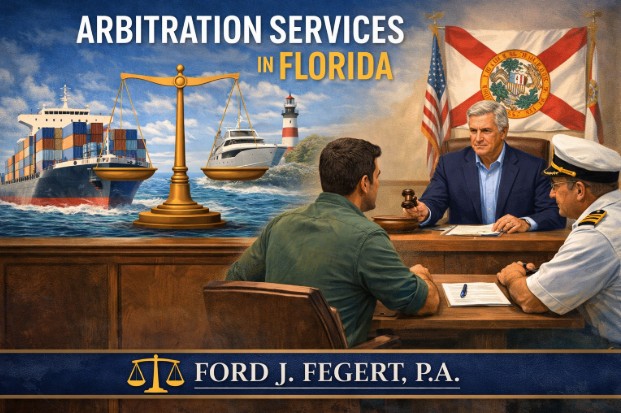
Ford J. Fegert holds Florida Bar Board Certification in Admiralty and Maritime Law, the Proctor in Admiralty designation from the Maritime Law Association of the United States, Florida Supreme Court Certification as a Civil Mediator, and Florida Supreme Court Qualified Arbitrator designation — credentials built from more than 30 years of active litigation across Florida state courts and U.S. District Courts.
Ford J. Fegert, P.A., offers free arbitration consultations in Florida, available 24 hours a day, 7 days a week. Call 772-559-1984 or email vessellaw@aol.com to discuss your case today.
Arbitration is a formal, private dispute resolution process governed in Florida by the Florida Arbitration Code, Chapter 682 of the Florida Statutes. An impartial arbitrator — or a panel of arbitrators — hears evidence, reviews legal arguments, and issues a binding or non binding written decision called an arbitration award.
Florida courts enforce arbitration awards as court judgments. The arbitrator decides the outcome. The parties do not negotiate one.
Arbitration differs from mediation in a fundamental way. Mediation is voluntary — a neutral facilitator helps parties reach their own agreement. Arbitration is adjudicative — the arbitrator hears both sides and decides.
Arbitration differs from litigation in three equally important ways. First, arbitration hearings are private. Second, parties select their arbitrator. Third, arbitration resolves disputes in months rather than years.
Interstate and international commercial arbitration may also fall under the Federal Arbitration Act, 9 U.S.C. § 1 et seq., as well as Florida’s Chapter 682 framework.
| Feature | Arbitration | Mediation | Litigation |
| Decision-maker | Arbitrator decides | Parties decide together | The judge or jury decides |
| Outcome | Binding award | Voluntary agreement | Court judgment |
| Privacy | Private, no public record | Confidential by law | Public court record |
| Speed | Months | Hours to days | Two to five years |
| Party control | Arbitrator selection only | Full control over outcome | No control |
| Appealability | Narrow grounds only | Not applicable | Full appellate review |
| Cost | Lower than litigation | Lowest of the three | Highest |
| Subject-matter expertise | The party selects a qualified arbitrator | The party selects a qualified mediator | Assigned judge, no selection |
Many parties arrive at arbitration in one of three ways. Some agree to arbitration in advance by including an arbitration clause in a contract before any dispute arises. Some Courts issue Orders compelling the Parties to conduct non binding arbitration as an expedited means of dispute resolution. Others choose arbitration after a dispute develops, when both sides recognize that litigation will cost more than the conflict is worth.
Arbitration works particularly well when a dispute involves technical subject matter that a general civil court jury would struggle to evaluate.
Maritime operations, insurance policy interpretation, medical malpractice disputes, construction defects, and commercial real estate terms all benefit from an arbitrator with direct industry experience.
Ford J. Fegert, P.A., is especially well-positioned to arbitrate disputes involving admiralty and maritime law, marine insurance, civil liability, medical malpractice, and real estate — the same subject areas in which Ford J. Fegert spent more than three decades as a practicing attorney.
Florida private arbitration costs depend on the arbitrator’s hourly rate, the complexity of the dispute, and the anticipated hearing length. Experienced private arbitrators in Florida charge $350 to $800 per hour.
Florida Senate Private binding arbitration — selected voluntarily by the parties — is not subject to that statutory cap, and experienced subject-matter expert arbitrators command market rates reflecting their specialized credentials.
A typical Florida private arbitration hearing runs four to eight hours for straightforward disputes.
A commercial contract or insurance coverage arbitration between two parties resolves in a half-day to full-day hearing, with total arbitrator costs of $1,200 to $6,400 per side.
Complex multi-party maritime arbitration or medical malpractice arbitration proceedings may require multiple hearing days, with total arbitrator costs divided equally between the parties unless their arbitration agreement provides otherwise.
Florida state court litigation produces a dramatically higher total cost. Both sides absorb discovery costs, expert witness fees, court filing expenses, and attorney preparation time for one to three years before trial.
Arbitration eliminates extended discovery, motion practice, and pre-trial hearings — redirecting those costs toward resolution rather than combat.
| Cost Item | Private Arbitration | Florida State Court Litigation |
| Arbitrator fee | $350–$800 per hour per side | Not applicable |
| Typical half-day hearing total | $900–$3,200 per side | Not applicable |
| Typical full-day hearing total | $1,200–$6,400 per side | Not applicable |
| Discovery costs | Streamlined by party agreement | Full civil discovery — extensive |
| Time to resolution | Months | Two to three years average |
| Appealability | Narrow grounds only | Full appellate review available |
| Total dispute cost | Significantly lower | Often exceeds $15,000–$100,000+ per side |
Florida Statutes § 44.108 governs court-funded arbitration programs for qualifying lower-value civil disputes.
Parties whose disputes involve higher claim amounts, specialized subject matter, or confidentiality requirements benefit from selecting a private arbitrator with direct expertise in the relevant dispute category.
| Dispute Category | Common Arbitration Subjects |
| Maritime and Admiralty | Jones Act injury claims, vessel ownership conflicts, charter party disputes, marine insurance coverage, maritime lien priority, collision liability |
| Insurance Coverage | Coverage denials, claim valuation disputes, bad faith handling, policy interpretation conflicts |
| Civil and Commercial | Contract disagreements, business partnership conflicts, professional liability, and commercial negligence |
| Real Estate and Construction | Transaction disputes, contractor negligence, construction defects, and property condition disagreements |
| Medical Malpractice and Healthcare | Malpractice claims, billing disputes, professional liability, and healthcare provider conflicts |
Maritime and Admiralty Disputes: Maritime arbitration resolves Jones Act seaman injury claims, vessel ownership conflicts, marine insurance coverage disagreements, charter party disputes, maritime lien priority conflicts, and collision liability questions. Ford J. Fegert’s Florida Bar Board Certification in Admiralty and Maritime Law and Proctor in Admiralty designation — the highest honorary recognition in American maritime law — make Ford J. Fegert one of the most qualified maritime arbitrators practicing in Florida.
Insurance Coverage and Claims Disputes: Insurance arbitration resolves conflicts between policyholders and insurers over coverage denials, claim valuations, bad-faith claims handling, and policy interpretation. Arbitration keeps both parties’ coverage positions and claim valuations out of the public court record — protecting insurers, policyholders, and P&I clubs from reputational exposure.
Civil and Commercial Disputes: Contract disagreements, business partnership conflicts, professional liability claims, and commercial negligence disputes can be resolved efficiently through arbitration. Both sides receive a binding decision without the cost and delay of Florida state court litigation.
Real Estate and Construction Disputes: Real estate transaction disputes, construction contract conflicts, contractor negligence claims, and property defect disputes frequently include pre-existing arbitration clauses in purchase agreements and construction contracts. Ford J. Fegert administers these proceedings under the Florida Arbitration Code, Chapter 682.
Medical Malpractice and Healthcare Disputes: Healthcare providers, medical facilities, and patients resolve medical malpractice claims, billing disputes, and professional liability conflicts privately through arbitration. Ford J. Fegert’s background in healthcare litigation informs every medical arbitration proceeding Ford J. Fegert oversees.
| Benefit | Arbitration | Florida State Court Litigation |
| Time to resolution | Months | Two to three years average |
| Public record | No | Yes |
| Arbitrator/judge selection | Yes — parties choose | No — judge assigned |
| Finality | Binding, limited appeal | Subject to full appellate review |
| Discovery scope | Streamlined by agreement | Full civil discovery |
| Hearing location | Flexible, party-controlled | Court-assigned |
| Cost | Significantly lower | Significantly higher |
Speed. Florida state court litigation takes an average of two to three years to reach trial. Arbitration produces a final binding decision in a fraction of that time — often within months of the initial filing.
Privacy. Arbitration proceedings and awards are not part of the public court record. Businesses, healthcare providers, and maritime companies protect sensitive commercial and operational information by resolving disputes through arbitration rather than open court.
Control Over the Decision-Maker. Parties in litigation cannot choose their judge. Parties in arbitration select their arbitrator — or agree on a selection process — so the decision-maker brings relevant subject-matter expertise rather than a general civil docket background.
Finality. Florida law limits appeals from arbitration awards to narrow grounds — arbitrator misconduct, fraud, corruption, or clear legal error exceeding the arbitrator’s authority. Both sides receive a final resolution without the risk of years of appellate review.
Flexibility. Parties control the arbitration schedule, hearing location, rules of evidence, and procedural format. Arbitration adapts to the needs of the dispute rather than requiring the dispute to fit the court’s calendar.
Cost. Arbitration eliminates extended discovery, motion practice, pre-trial hearings, and jury costs. Both sides direct those resources toward their businesses rather than their attorneys.
Ford J. Fegert, P.A., arbitrates maritime, insurance, civil, and commercial disputes throughout Florida’s Treasure Coast and beyond. Call 772-559-1984 today for a free, confidential consultation.
The quality of an arbitration proceeding depends on the arbitrator’s subject-matter knowledge. An arbitrator without industry experience produces decisions that neither side fully trusts. Ford J. Fegert addresses that concern directly.
| Credential | Issuing Body | Year |
| Proctor in Admiralty | Maritime Law Association of the United States | 1991 |
| Florida Bar Board Certified — Admiralty and Maritime Law | The Florida Bar | 1997 |
| Florida Supreme Court Certified Civil Mediator Florida Supreme Court Qualified Arbitrator | Florida Supreme Court | 2005 |
| J.D. — Admiralty and Maritime Law Emphasis | Tulane University School of Law | 1984 |
| Member — Florida Bar, California Bar, Louisiana Bar | Respective State Bars | Active |
Ford J. Fegert spent more than 30 years litigating maritime, medical malpractice, personal injury, and insurance matters in Florida state courts, U.S. District Courts for the Southern and Middle Districts of Florida, and the U.S. Court of Appeals for the Ninth Circuit.
Ford J. Fegert represented ship owners, seamen, charterers, underwriters, marina operators, and healthcare providers — on both sides of the disputes he now arbitrates.
That litigation background matters in arbitration. Ford J. Fegert evaluates evidence the way a federal court would, calculates damages using the same frameworks his former clients used, and identifies weak arguments before they cost either side additional time.
Parties on both sides receive a decision grounded in 30 years of firsthand legal experience — not procedural guesswork.
Ford J. Fegert arbitrates disputes arising throughout south-central and coastal Florida, including Vero Beach, Fort Pierce, Stuart, Orlando, and surrounding communities. Online arbitration is available for parties located outside Florida.
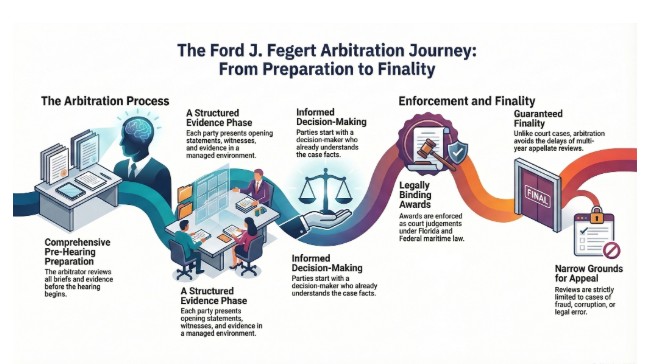
Pre-Hearing Preparation: Ford J. Fegert reviews submitted briefs, contracts, expert reports, and case materials before the arbitration hearing. Both parties begin the hearing with a decision-maker who has already studied the relevant documents, not one encountering the facts for the first time at the conference table.
The Arbitration Hearing: It follows a structured yet flexible format. Each side presents opening statements, introduces evidence, examines witnesses, and delivers closing arguments. Ford J. Fegert controls the proceedings, manages evidentiary objections, and ensures that both sides receive a full and fair opportunity to present their cases.
The Arbitration Award: Following the hearing, Ford J. Fegert issued a written arbitration award. Florida courts enforce arbitration awards as court judgments under Chapter 682 of the Florida Statutes. Federal courts with admiralty jurisdiction enforce maritime arbitration awards under the Federal Arbitration Act, 9 U.S.C. § 1 et seq.
Appeals: Florida law limits review of arbitration awards to narrow grounds — arbitrator misconduct, fraud, corruption, or clear legal error exceeding the arbitrator’s authority. A binding arbitration award delivers finality that court judgments, subject to multi-year appellate review, cannot guarantee.
What is arbitration, and how does it differ from mediation?
Arbitration is a private process where a neutral arbitrator hears both sides and issues either a non-binding or binding decision based on the election of the Parties, the Court’s Order compelling arbitration. Mediation is voluntary — a neutral facilitator facilitates negotiation but does not decide the outcome. The arbitrator decides. The mediator does not.
Is arbitration binding in Florida?
Yes. Binding arbitration awards under the Florida Arbitration Code, Chapter 682, are enforceable in Florida state court. Awards are reviewable only on narrow grounds, including arbitrator fraud, misconduct, or clear excess of authority.
Can parties choose their arbitrator in Florida?
Yes. Florida arbitration parties select their arbitrator by mutual agreement or through a process defined in their arbitration clause. An arbitrator with direct subject-matter expertise produces more informed decisions than an assigned judge.
What disputes are best suited for arbitration? Arbitration suits technically complex disputes — maritime operations, insurance coverage, construction defects, medical malpractice, and commercial contracts. A subject-matter expert arbitrator resolves these disputes more efficiently than a general civil court jury.
How long does arbitration take in Florida?
Florida arbitration proceedings typically resolve within several months of filing. Multi-party commercial disputes may require longer preparation. Both timelines compare favorably with Florida state court litigation, which averages 2 to 3 years from filing to trial.
Does arbitration keep the dispute private?
Yes. Arbitration proceedings and awards are not part of the public court record. Parties protect sensitive commercial information, insurance positions, and business operations through arbitration rather than open court litigation.
What happens if one party refuses to honor the arbitration award?
A party that refuses to comply with a binding arbitration award faces court enforcement proceedings. Florida courts confirm and enforce arbitration awards under Chapter 682. The prevailing party petitions the court for confirmation, and the award becomes an enforceable court judgment.
Can arbitration resolve maritime disputes in Florida?
Yes. Maritime arbitration resolves Jones Act injury claims, conflicts in marine insurance coverage, charter party disputes, vessel ownership disputes, and maritime lien priority questions. Ford J. Fegert’s Florida Bar Board Certification in Admiralty and Maritime Law makes Ford J. Fegert one of Florida’s most qualified maritime arbitrators.
Ford J. Fegert, P.A. — Florida Bar Board Certified in Admiralty and Maritime Law and Florida Supreme Court Certified Civil Mediator — provides binding arbitration services throughout Florida. Call 772-559-1984 for a free consultation.
