
Admiralty and maritime mediation is a confidential, voluntary dispute resolution process in which a neutral mediator helps parties in a maritime conflict negotiate a settlement outside of court.
In Florida, certified maritime mediators handle disputes involving marine insurance, vessel ownership, seaman injury, passenger injuries and claims, maritime liens, collisions, charter parties, cargo claims, and more.
Maritime and admiralty disputes are among the most technically complex cases in American law. They involve specialized federal statutes, international conventions, and industry customs that most judges and jurors have never encountered.
Resolving these cases through litigation can take years and cost both sides enormous sums, with no guarantee of a predictable outcome.
There is a better path. Ford J. Fegert, P.A., brings a combination of credentials that is exceptionally rare in Florida dispute resolution: Florida Bar Certification in Admiralty and Maritime Law and Florida Supreme Court Certification as a Civil Mediator.
That means the person guiding your negotiation is not a generalist who studied maritime law in a seminar, but a lawyer who has spent decades representing ship owners, seamen, charterers, underwriters, and healthcare providers in exactly the kinds of cases you are now facing.
Ford J. Fegert, P.A., offers free admiralty and maritime mediation consultations in Florida, available 24 hours a day, 7 days a week. Call 772-559-1984 to discuss your Jones Act claim, marine insurance dispute, or vessel ownership conflict today.
Admiralty and maritime mediation is a structured, confidential negotiation process in which a Florida Supreme Court Certified Civil Mediator — serving as a neutral third party with no financial stake in the outcome — facilitates settlement discussions between opposing parties in a maritime dispute.
The mediator does not issue a ruling, render a verdict, or decide liability. The disputing parties negotiate and sign any resulting settlement agreement voluntarily.
Florida maritime mediators apply two primary methodologies depending on the nature of the dispute.
Facilitative maritime mediation prioritizes communication: the mediator helps each party understand the opposing position, identify shared commercial interests, and realistically assess litigation risk — so parties can make informed decisions without a court imposing one.
Evaluative maritime mediation applies when parties request an informed assessment of how a federal admiralty court would likely value each side’s position, drawing on the mediator’s direct litigation experience in admiralty and maritime law.
Ford J. Fegert, P.A. applies both facilitative and evaluative approaches to maritime mediation, selecting the methodology that best fits the complexity of the dispute, the parties’ relationship, and the stage of any pending federal litigation.
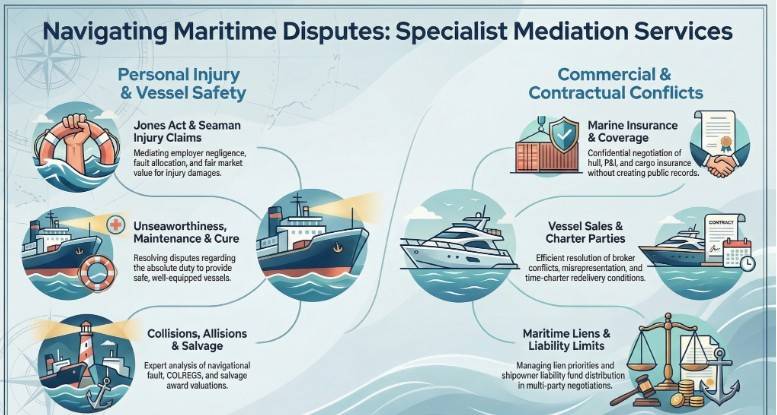
Ford J. Fegert mediates admiralty and maritime disputes arising under federal admiralty law, Florida state maritime statutes, and applicable international conventions, including:
Jones Act Claims and Seaman Injury: Jones Act claims — filed under 46 U.S.C. § 30104 by seamen injured during the course of employment on a vessel in navigation — are among the most frequently mediated maritime matters in Florida federal courts.
Jones Act mediation addresses employer negligence, comparative fault allocation, unseaworthiness as a companion claim, and the fair market value of injury damages. Ford J. Fegert has litigated Jones Act matters on behalf of both seamen and vessel owners, providing firsthand valuation insight that accelerates settlement.
Unseaworthiness and Maintenance and Cure: Vessel owners owe seamen an absolute, non-delegable duty to provide a seaworthy vessel under federal admiralty law. Unseaworthiness claims arise when defective equipment, inadequate crew competence, or unsafe vessel conditions breach that duty.
Maintenance and cure disputes — covering a seaman’s right to daily living expenses and medical treatment from the date of injury through maximum medical improvement — frequently proceed as standalone mediation subjects separate from Jones Act negligence claims.
Marine Insurance and Coverage Disputes: Marine insurance mediation resolves conflicts involving hull and machinery coverage, protection and indemnity (P&I) insurance, cargo insurance, underwriter coverage denials, and bad faith claims handling.
Florida maritime mediation protects both insurers and policyholders from public disclosure of claim valuations, reserve positions, and coverage interpretations — so parties can negotiate candidly without creating a public record.
Vessel Ownership, Sales, and Broker Disputes: Yacht and vessel purchase disputes — including seller misrepresentation of vessel condition, failure to disclose structural defects, marine survey disputes, broker commission conflicts, and vessel title defects — resolve more efficiently in mediation than in state or federal court.
Mediation preserves the commercial relationships between brokers, buyers, sellers, and marine lenders that adversarial litigation destroys.
Maritime Liens and Ship Mortgages: Maritime lien priority disputes, preferred ship mortgage foreclosures, and lien claimant conflicts arising under 46 U.S.C. Chapter 313 require a mediator who understands the federal statutory framework governing maritime liens, the rank order of competing lien classes, and the practical consequences of vessel arrest proceedings.
Ford J. Fegert has represented both lien claimants and vessel owners in federal maritime lien proceedings.
Limitation of Liability Actions: Vessel owners petitioning a federal admiralty court to limit liability under the Limitation of Shipowner’s Liability Act face competing claimant demands, fund distribution disputes, and multi-party negotiation challenges that mediation resolves more efficiently than extended federal litigation.
Ford J. Fegert structures limitation-mediation sessions to address claimant priority, fund allocation, and settlement-release terms in a single proceeding.
Vessel Collisions, Allisions, and Salvage: Vessel collision and allision cases require COLREGS (International Regulations for Preventing Collisions at Sea) analysis, allocation of navigational fault, and coordination with technical experts that most trial judges and jurors cannot evaluate without substantial education.
Salvage disputes involve LOF (Lloyd’s Open Form) contract interpretation, valuation of salvage awards, and special compensation claims under Article 14 of the 1989 International Salvage Convention. Mediation resolves both categories of dispute between parties who already understand the technical facts.
Charter Party Disputes: Bareboat charter and time charter disputes — including demurrage claims, off-hire disagreements, breach-of-charter-party allegations, and conflicts over redelivery conditions — are regularly mediated because both charterers and shipowners benefit from a faster, private resolution that preserves ongoing commercial charter relationships.
Marina and Waterfront Operations: Slip lease disputes, dock damage liability claims, marina operator negligence conflicts, and waterfront property boundary disputes arising in Florida’s coastal jurisdictions are resolved through maritime mediation when the parties seek a confidential, binding outcome without the expense of state court litigation.
Ford J. Fegert, P.A. mediates Jones Act claims, marine insurance disputes, vessel lien actions, and charter party conflicts throughout Florida’s Southern and Middle Federal Districts. Call 772-559-1984 today — the consultation is free, and the conversation is confidential.
Federal maritime litigation in Florida produces a predictable pattern: depositions begin within six months, expert witnesses are retained within twelve, and trial — if it occurs — arrives two to five years after filing.
Each phase generates attorney fees, expert costs, and opportunity costs that accumulate on both sides regardless of who ultimately prevails.
Speed. Florida maritime mediation resolves disputes that federal court litigation would take two to five years to adjudicate. A mediated settlement agreement can be negotiated, drafted, and signed within a single half-day or full-day session.
Control Over the Outcome. Federal judges and juries decide liability and damages in litigation — parties do not. Maritime mediation returns decision-making authority to the vessel owners, insurers, seamen, and commercial parties who understand the technical and commercial facts of the dispute, so outcomes reflect industry reality rather than courtroom guesswork.
Confidentiality Protected by Florida Law. Florida Statutes § 44.405 protects all mediation communications from disclosure in subsequent legal proceedings. No public court record documents the parties’ positions, claim valuations, reserve figures, or settlement terms — a critical protection for marine insurers, P&I clubs, and publicly traded shipping companies managing reputational risk.
No Precedent Created. A mediated maritime settlement applies exclusively to the signing parties and creates no judicial precedent. When a vessel accident involves rare navigational conditions, unusual cargo configurations, or novel equipment failures, neither party benefits from a published court ruling that reshapes industry standard-of-care expectations or triggers copycat claims.
Cost Reduction. Maritime mediation compresses months of federal litigation expense into hours of structured negotiation. Both parties redirect expert witness fees, deposition costs, and attorney time toward productive commercial activity rather than adversarial discovery.
Commercial Relationship Preservation. Maritime disputes frequently arise between charter partners, vessel operators and marine insurers, marina operators and slip tenants, and ship brokers and repeat clients — parties whose ongoing commercial relationships generate more long-term value than any single litigation victory. Mediation provides a resolution path that adversarial federal litigation does not.
Proctor in Admiralty, Maritime Law Association of the United States (1991): The Proctor in Admiralty designation is the highest honorary recognition awarded in American maritime law.
The Maritime Law Association of the United States confers the Proctor in Admiralty title on attorneys who have demonstrated sustained excellence in admiralty practice through peer evaluation — not through a course, examination, or self-designation.
Ford J. Fegert earned the Proctor in Admiralty designation in 1991, placing him among a small national cohort of admiralty practitioners recognized at that level.
Florida Bar Board Certified in Admiralty and Maritime Law (1997): Florida Bar Board Certification in Admiralty and Maritime Law requires an attorney to demonstrate substantial, sustained involvement in admiralty practice, pass a written examination administered by The Florida Bar, and submit to peer evaluation by other Florida maritime practitioners.
Florida Bar Board Certification in Admiralty and Maritime Law is held by fewer attorneys in Florida than any other legal specialty certification that The Florida Bar administers.
Florida Supreme Court Certified Civil Mediator (2005): Florida Supreme Court Certification as a Civil Mediator requires completion of Florida’s Supreme Court-approved mediator training curriculum, satisfaction of co-mediation and observation hour requirements, and passage of Florida’s mediator certification evaluation.
Ford J. Fegert combined Florida Supreme Court Civil Mediator Certification with Florida Bar Board Certification in Admiralty and Maritime Law — a dual credential that fewer than a handful of Florida neutrals hold simultaneously.
Prior to becoming a Florida Supreme Court Certified mediator, as early as 1999, Ford J. Fegert was appointed as mediator by the Court for Florida 19th Judicial Circuit. .
40-Plus Years of Active Maritime Litigation: Ford J. Fegert began his maritime law career as a law clerk with Normann & Normann, a New Orleans maritime firm, before joining Meadows, Smith & Brown in San Francisco as an associate.
Ford J. Fegert joined The Florida Bar in 1990 and spent more than 30 years representing ship owners, seamen, charterers, underwriters, marina operators, and healthcare providers in the Florida state courts, U.S. District Courts for the Southern and Middle Districts of Florida, and the U.S. Court of Appeals for the Ninth Circuit.
Ford J. Fegert co-founded Garris & Fegert LLP in 2004 and, thereafter, established Ford J. Fegert, P.A., which has focused exclusively on mediation for the past decade.
Published Maritime Law Scholarship: Ford J. Fegert has contributed scholarship to the University of South Florida Maritime Law Journal and lectured on admiralty and maritime law topics — providing the academic engagement with maritime legal doctrine that distinguishes a subject-matter expert mediator from a process-only neutral.
Ford J. Fegert, P.A. serves parties in admiralty and maritime mediation throughout Florida, including disputes filed in or connected to the U.S. District Court for the Southern District of Florida (Miami, Fort Lauderdale, West Palm Beach) and the U.S.
District Court for the Middle District of Florida (Orlando, Tampa, Jacksonville) — the two federal courts that handle the majority of admiralty litigation filed in Florida.
Ford J. Fegert’s geographic practice covers Florida’s full Atlantic and Gulf coastlines, including commercial port facilities at Port Everglades (Fort Lauderdale), the Port of Miami, Port Canaveral (Brevard County), the St. Lucie Inlet (Martin County), and Gulf Coast ports serving Florida’s commercial fishing, offshore energy, and cargo industries.
Online maritime mediation is available for parties whose principals, counsel, or insurers are located outside Florida — removing geographic barriers from multi-jurisdictional admiralty disputes involving out-of-state vessel owners, foreign underwriters, or international charterers.
Pre-Session Preparation: Ford J. Fegert reviews all submitted mediation briefs, case summaries, expert reports, and core factual materials before the session date. Parties begin mediation with a mediator who has already studied the vessel specifications, accident timeline, insurance policy language, or lien documentation at issue — not one who encounters the facts for the first time at the conference table.
Opening Joint Session: Maritime mediation sessions begin with all parties and their counsel present. Ford J. Fegert explains the voluntary and confidential nature of the Florida mediation process under Florida Statutes § 44.405, confirms each party’s authority to settle, clarifies his role as a neutral facilitator with no adjudicative authority, and establishes ground rules for productive negotiation.
Private Caucuses: Following the joint opening session, parties move into separate caucuses. Ford J. Fegert meets privately with each side to explore commercial interests underlying stated legal positions, stress-test each party’s litigation risk assessment against the actual evidentiary record, surface settlement structures neither party has proposed, and help each party evaluate the realistic net value of their position after continued litigation costs.
Settlement Agreement: When parties reach an agreement, Ford J. Fegert documents the settlement terms in a written settlement agreement signed by all parties and their counsel — a binding, enforceable contract under Florida law. Florida Statutes § 44.405 protects all mediation communications from disclosure, so the settlement terms remain confidential unless the parties agree otherwise.
Impasse and Partial Agreement. When a full settlement agreement is not reached on the day of the session, partial agreements that narrow the disputed issues for subsequent litigation are common and reduce ongoing litigation costs for both sides.
Parties whose mediation session ends at impasse retain all litigation rights, and no statement made during mediation may be introduced as evidence in subsequent federal or state court proceedings.
What is admiralty and maritime mediation under Florida and federal law?
Admiralty and maritime mediation is a confidential, voluntary process under 28 U.S.C. § 1333 where a certified neutral facilitates settlement between maritime disputants — including vessel owners, seamen, and marine insurers — without federal court adjudication.
What is the Jones Act, and how does maritime mediation resolve Jones Act claims?
The Jones Act, codified at 46 U.S.C. § 30104, gives injured seamen the right to sue employers for negligence. Maritime mediation resolves Jones Act claims privately and faster than federal court litigation allows.
Is a maritime mediation settlement legally binding in Florida?
A maritime mediation settlement is legally binding when all parties sign the written agreement. Florida Statutes § 44.405 protects all mediation communications from disclosure in any subsequent federal or state court proceeding.
Can maritime mediation proceed while a federal admiralty case is already filed?
Yes. Maritime mediation proceeds during active federal litigation. The U.S. District Courts for the Southern and Middle Districts of Florida routinely order mediation in pending admiralty cases without suspending existing litigation deadlines.
What maritime disputes are most commonly resolved through mediation in Florida?
Florida maritime mediation most commonly resolves Jones Act injury claims, marine insurance coverage disputes, vessel collision cases, maritime lien priority conflicts, charter party disagreements, limitation of liability proceedings, and yacht purchase misrepresentation claims.
Who participates in a Florida maritime mediation session?
Florida maritime mediation participants include vessel owners, injured seamen, P&I club representatives, hull underwriters, charterers, ship brokers, marina operators, and their respective maritime attorneys — all present with full authority to negotiate and sign a binding settlement.
How long does a Florida admiralty mediation session take?
The length of a Florida admiralty mediation session depends on case complexity. A marine insurance coverage dispute typically resolves in three to four hours. A complex Jones Act wrongful death case may require a full day or multiple sessions.
Does Ford J. Fegert represent either party during maritime mediation?
Ford J. Fegert serves exclusively as a neutral mediator and represents neither party. As a Florida Supreme Court Certified Civil Mediator, Ford J. Fegert facilitates negotiation only — parties retain their own maritime attorneys throughout the process.
